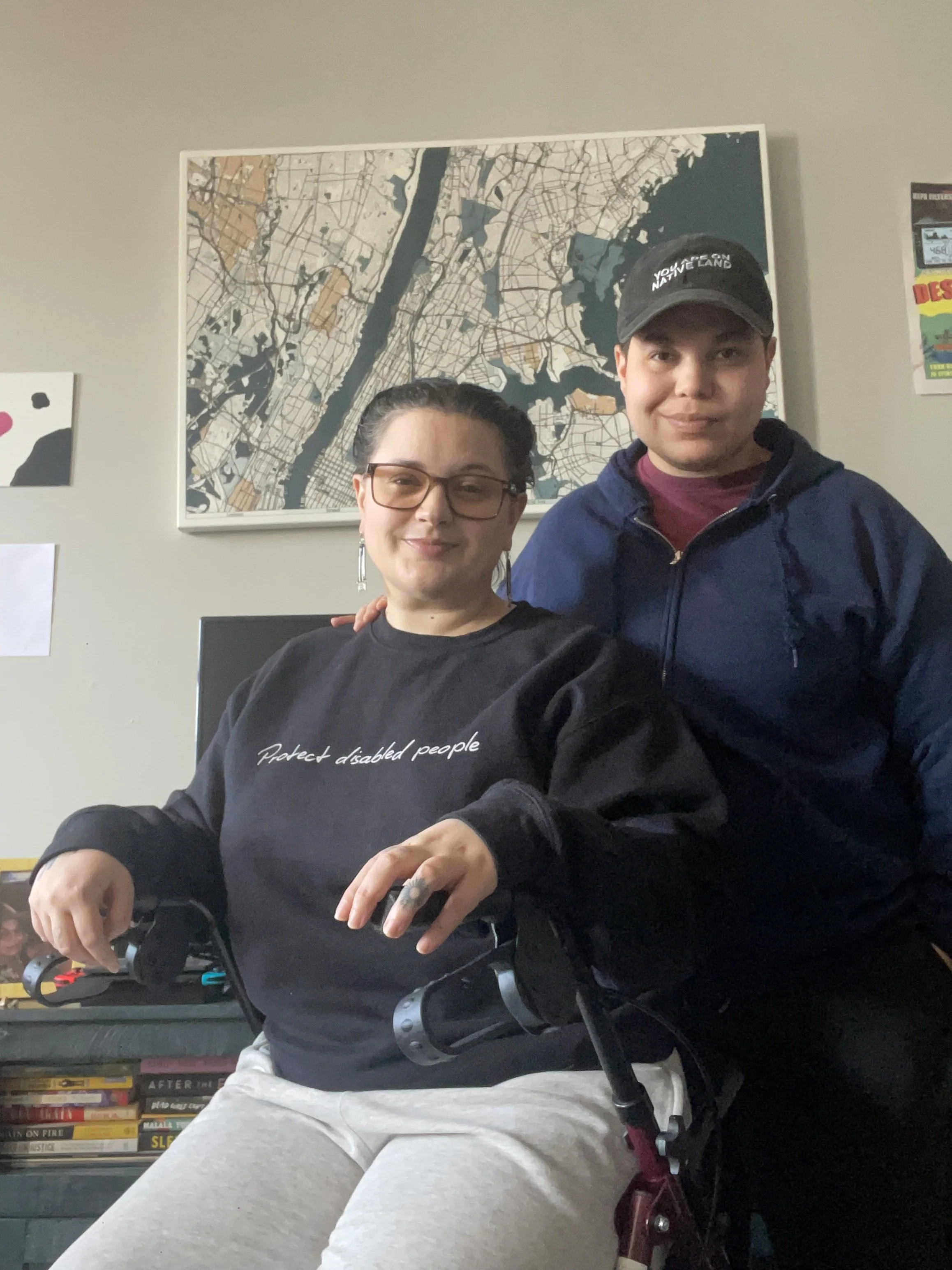

On October 14, 2026, The Dugger Law Firm, PLLC filed a motion for partial summary judgment on behalf of Marissa Kubicki in her disability accommodation lawsuit against The Legal Aid Society. The motion asks the United States District Court for the Southern District of New York to hold Legal Aid liable on her individual failure-to-accommodate claim under the New York City Human Rights Law, N.Y.C. Admin. Code § 8-107(15).
This article summarizes Ms. Kubicki’s filed submissions and legal arguments, not findings by the Court. Legal Aid disputes liability and has moved to dismiss the amended complaint.
The request at the center of the motion was straightforward. According to Ms. Kubicki’s submissions, she was not asking for additional work-from-home days or permission to stop attending court. She merely sought to continue the same approach to court coverage she had successfully used for more than two years: working from Legal Aid’s own office across the street from the Bronx courthouse and attending court whenever a client, attorney, hearing, or emergency actually required her presence.
The motion argues that Legal Aid’s written denials, constructive denial, performance evaluations, workplace records, and Ms. Kubicki’s prior successful use of the same office-based court-coverage arrangement, together with supporting declarations, establish that it unlawfully refused an accommodation that would have allowed Ms. Kubicki to protect her health while continuing to serve clients.
A Request to Continue Working as Before, Not Additional Work-From-Home Days
Ms. Kubicki is a Licensed Master Social Worker who began working for Legal Aid in 2019 and joined its Parole Revocation Defense Unit in 2023. Her job responsibilities included client interviews, assessments, mitigation, referrals, attorney consultation, and court advocacy.
Ms. Kubicki has been diagnosed with a condition called ankylosing spondylitis and was receiving immunosuppressive treatment when she submitted her accommodation request to Legal Aid. On November 24, 2025, she provided Legal Aid medical documentation supporting limits on unnecessary courthouse exposure while preserving necessary court attendance.
Legal Aid had already approved a hybrid schedule and other accommodations, and Ms. Kubicki was not requesting additional remote work days. Rather, this request concerned where she would work during her existing in-person days.
Her proposed arrangement would have used her assigned, already-equipped Legal Aid office, which was an approximately five-minute walk to the courthouse, rather than working within the courthouse when she did not have responsibilities requiring her presence in court, as she had previously done for two years. According to her submissions, Ms. Kubicki would have remained available through existing telephone, email, and Microsoft Teams communications and continued to prioritize court needs.
She did not request different hours, additional staff, a new position, or reassignment of her clients and court responsibilities.
An Oral Denial Followed by Two Written DENIALS
The motion focuses on two written refusals by Legal Aid to provide the requested interim accommodation while it continued reviewing Ms. Kubicki’s request. Those refusals followed an earlier oral denial. According to Ms. Kubicki’s declaration, at a December 26, 2025 meeting attended by union delegate Hayley Feldman, Legal Aid’s Senior Employee Relations Specialist, Laura Walsh, told her that her request to work from Legal Aid’s office across the street and attend court as needed was being denied.
On January 12, 2026, Legal Aid’s then-Chief Human Resources Officer, Connie Park, wrote to Ms. Kubicki: “The interim request to remain in the LAS office until requested in court, rather than working from the court location, is not approved.” The email also stated that Legal Aid needed additional information to evaluate the requested accommodation or potential alternatives.
On January 20, 2026, Park reaffirmed in writing that the interim accommodation “was denied and remains so,” citing management’s position that in-person court coverage was an essential function. Ms. Kubicki’s motion challenges those refusals because her proposed arrangement preserved necessary court attendance while allowing her to work from Legal Aid’s nearby office between court needs.
Legal Aid’s Own Evaluations and Prior Workplace Practices Support the Motion
The motion argues that Ms. Kubicki’s proposed arrangement was grounded in actual workplace experience, not speculation about whether the job could be performed differently.
Ms. Kubicki’s declaration describes an established practice of working from the office between court needs and responding when assistance was required. A supporting declaration from former Bronx Parole Revocation Defense Unit social worker Luca Verano Diaz describes the same approach, including prioritizing court requests while performing other assigned work from the office.
Legal Aid’s own performance evaluations are also central to Ms. Kubicki’s argument.
Ms. Kubicki’s March 2025 evaluation, which discussed her work with accommodations already in place, stated that “her work has not been impacted.” It credited her communication and collaboration with colleagues, availability for referrals, and management of her workload.
Ms. Kubicki relies on those evaluations, together with the evidence of prior office-based court coverage, to challenge the contention that her proposed arrangement was incompatible with effective client service.
The motion draws a distinction between performing essential court services and remaining physically in the courthouse when no identified task requires an employee to be there. Ms. Kubicki argues that she sought to continue her prior practice of remaining available from Legal Aid’s office between court needs, not to change the responsibilities she was required to fulfill.
The Motion Challenges Legal Aid’s Essential-Functions and Undue-Hardship Defenses
Ms. Kubicki’s motion argues that Legal Aid cannot show that the proposed accommodation would have prevented her from meeting the essential requirements of her job or imposed an undue hardship on Legal Aid.
It emphasizes that the requested accommodation would have utilized existing office, equipment, and communication systems, the office’s proximity to the courthouse, and Ms. Kubicki’s continued responsibility for her hours, caseload, and necessary court attendance.
The motion argues that the New York City Commission on Human Rights’ Legal Enforcement Guidance on Discrimination on the Basis of Disability supports Ms. Kubicki’s accommodation claim. Its “Leave, Scheduling, and Remote Work” section explains that the mere fact an employee would work outside the physical office “generally will not be sufficient to support an undue hardship defense.” Rather than relying on blanket remote-work restrictions, employers must engage in a cooperative dialogue and individually assess whether the employee’s specific tasks can be performed remotely or another accommodation would meet the employee’s needs. The employer must identify why that particular employee’s absence would create undue hardship in relation to the position’s essential duties, or show that it offered another accommodation meeting the employee’s needs. N.Y.C. Comm’n on Hum. Rts., Legal Enforcement Guidance on Discrimination on the Basis of Disability pt. II(A)(iii)(d), at 56–57 (Dec. 2025).
The motion further argues that the guidance supports evaluating Ms. Kubicki’s actual work practices, rather than treating Legal Aid’s characterization of courthouse presence as conclusive. The guidance requires a fact-specific inquiry into both the employer’s description of the position and “how the job is actually performed in practice.” A written job description is relevant, but does not conclusively establish which duties are essential. Id. pt. II(A)(iv)(b), at 61–62.
The motion also rejects the proposition that by continuing to discuss an accommodation, an employer can be excused for failing to provide one. It asserts that City law expressly states that compliance with the cooperative-dialogue requirement is not a defense to a failure-to-accommodate claim. N.Y.C. Admin. Code § 8-107(28)(f).
Later Accommodation Proposals Do Not Resolve the Earlier Denials, Ms. Kubicki Argues
According to Ms. Kubicki’s motion papers, on March 6, 2026, 102 calendar days after she requested the accommodation on November 24, 2025, Legal Aid proposed replacing preliminary courthouse visits with Teams messages to limit her in-person court time to that required to address client needs. The papers also state that Ms. Kubicki had begun medical leave on February 2, 2026, on her physician’s recommendation and remained on leave when Legal Aid made the March 6 proposal.
Ms. Kubicki argues that neither the March 6 proposal nor Legal Aid’s earlier alternative proposal erase the January written refusals or resolve whether Legal Aid unlawfully withheld an effective accommodation during the periods challenged in her motion.
What the Partial Summary Judgment Motion Seeks
Under Federal Rule of Civil Procedure 56(a), a court may resolve a claim or part of a claim without trial when there is no genuine dispute of material fact and the moving party is entitled to judgment as a matter of law.
Ms. Kubicki argues that the submitted evidence meets that standard for Legal Aid’s liability on her individual New York City Human Rights Law accommodation claim. Alternatively, she asks the Court to resolve particular issues or establish material facts for the remaining litigation.
The motion does not seek a damages award, a determination of medical causation, class certification, class-wide liability, or judgment against the other defendants. Those matters are reserved.
The Broader Legal Aid Society Disability Accommodation Lawsuit
As described in the firm’s earlier overview of the Legal Aid Society disability accommodation class action, the litigation challenges alleged practices extending beyond Ms. Kubicki’s individual request.
The amended complaint alleges denials of location-related accommodations, delays without effective interim protection, unnecessary demands for additional medical documentation, and retaliation involving changes or recharacterizations of job requirements after accommodation requests. It seeks class-wide changes to the challenged practices.
The partial summary judgment motion asks the Court only to decide Legal Aid’s responsibility for the specific accommodation refusals and related delay addressed in Ms. Kubicki’s individual claim.
The case is Kubicki v. The Legal Aid Society et al., No. 1:26-cv-03882-VSB-OTW, before U.S. District Judge Vernon S. Broderick and U.S. Magistrate Judge Ona T. Wang in the U.S. District Court for the Southern District of New York. The notice of motion appears at ECF No. 68, the statement of material facts at ECF No. 71, and the supporting memorandum at ECF No. 72. The amended complaint is available here.